kdolu
kdolu Agricultural Credit Corporation plays a very important role in modern farming. Every farmer needs money to buy seeds, fertilizer, machines, land, livestock, and many other farming supplies. However, many farmers do not have enough savings to cover these costs. That is why agricultural credit is so important.
Today, farming is no longer just about planting crops and raising animals. Instead, it has become a business that needs planning, investment, and smart financial decisions. As a result, farmers often depend on agricultural loans to keep their farms running smoothly.
In this complete guide, you will learn everything about Agricultural Credit Corporation, including its purpose, benefits, loan types, eligibility, application process, advantages, disadvantages, real-life examples, expert advice, and much more.
Whether you are a beginner, an experienced farmer, a student, or someone interested in agricultural finance, this guide will help you understand the topic in very simple language.
What Is Agricultural Credit Corporation?
The Agricultural Credit Corporation is a financial organization or lending system that provides money to farmers and agricultural businesses. Its main goal is to support farming activities by offering affordable credit.
Farmers need financial support throughout the year. For example, they may need money before planting crops. Later, they may need additional funds to harvest, transport, and sell their products.
Instead of waiting until harvest season, farmers can borrow money when they need it most.
As a result, agricultural production continues without unnecessary delays.
Why Agricultural Credit Corporation Is Important
Agriculture is one of the world’s oldest industries. Even today, millions of people depend on farming for food and income.
However, farming costs continue to increase every year.
Farmers need money for:
- Seeds
- Fertilizers
- Pesticides
- Irrigation systems
- Tractors
- Harvesters
- Livestock
- Animal feed
- Farm labor
- Transportation
Without affordable financing, many farms cannot grow successfully.
Therefore, the Agricultural Credit Corporation becomes an important partner for farmers.
History of Agricultural Credit Corporation
Agricultural lending has existed for hundreds of years.
In the past, farmers borrowed money from local landlords or private lenders. Unfortunately, many lenders charged very high interest rates.
Later, governments realized farmers needed better financial support.
As a result, many countries created agricultural banks, rural development programs, and agricultural credit corporations.
Today, these institutions help millions of farmers every year.
Main Goals of Agricultural Credit Corporation
Every Agricultural Credit Corporation works toward similar goals.
These goals include:
- Supporting food production
- Helping farmers increase income
- Improving rural communities
- Encouraging modern farming
- Reducing poverty
- Promoting sustainable agriculture
- Creating employment
- Increasing agricultural exports
Because agriculture supports entire economies, agricultural financing benefits everyone—not just farmers.
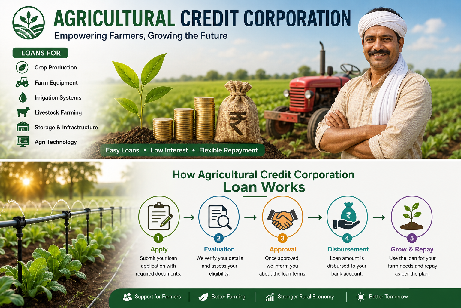
How Agricultural Credit Corporation Works
The lending process is usually simple.
Step 1: Farmer Applies
The farmer submits an application.
Step 2: Loan Review
The lender checks:
- Farm size
- Income
- Credit history
- Farming experience
- Loan purpose
Step 3: Approval
If everything meets the requirements, the loan receives approval.
Step 4: Funds Released
The farmer receives the money.
Step 5: Farm Investment
The farmer purchases equipment, seeds, livestock, or land improvements.
Step 6: Repayment
After harvesting or earning income, the farmer repays the loan according to the agreed schedule.
Different Types of Agricultural Credit Corporation Loans
Different farming activities require different loan types.
The most common categories include:
| Loan Type | Purpose | Repayment |
| Short-Term | Seasonal farming | Less than 1 year |
| Medium-Term | Equipment | 1–5 years |
| Long-Term | Land and buildings | More than 5 years |
Choosing the right loan depends on the farmer’s needs.
Agricultural Credit Corporation Short-Term Loans
Short-term loans help farmers cover seasonal expenses.
These loans usually pay for:
- Seeds
- Fertilizer
- Fuel
- Labor
- Animal feed
Farmers normally repay these loans after harvesting crops.
Because repayment happens quickly, interest costs are often lower.
Agricultural Credit Corporation Medium-Term Loans
Medium-term loans support farm improvements.
Farmers often use them for:
- Buying tractors
- Purchasing irrigation systems
- Building storage facilities
- Installing fencing
- Buying dairy equipment
These investments increase productivity for several years.
Therefore, repayment periods are longer.
Agricultural Credit Corporation Long-Term Loans
Long-term financing supports major investments.
Examples include:
- Buying farmland
- Building barns
- Constructing greenhouses
- Purchasing orchards
- Installing permanent irrigation
Since these projects last many years, repayment periods are also much longer.
Who Can Apply for Agricultural Credit Corporation Loans?
Eligibility varies by lender.
However, many applicants include:
- Crop farmers
- Livestock farmers
- Dairy farmers
- Poultry farmers
- Fish farmers
- Agricultural cooperatives
- Agribusiness companies
- Farm equipment businesses
- Young farmers
- Beginning farmers
Some programs also help women farmers and rural entrepreneurs.
Common Uses of Agricultural Credit Corporation Financing
Farmers use loans in many ways.
Popular purposes include:
- Buying quality seeds
- Purchasing fertilizer
- Expanding farmland
- Improving irrigation
- Buying livestock
- Repairing machinery
- Building storage facilities
- Purchasing tractors
- Starting greenhouse farming
- Organic farming projects
Each investment helps increase farm income over time.
Agricultural Credit Corporation and Rural Development
Agricultural finance does more than help individual farmers.
It also supports entire rural communities.
For example:
- New jobs are created.
- Local businesses grow.
- Better roads become possible.
- More food reaches markets.
- Family incomes improve.
- Young people find employment nearby.
As farming improves, rural economies become stronger.
Benefits of Agricultural Credit Corporation for Small Farmers
Small farmers often face the biggest financial challenges.
Fortunately, agricultural credit gives them opportunities to compete.
Major benefits include:
Better Crop Production
Farmers can buy better seeds and fertilizer.
Higher Income
Improved production usually leads to higher profits.
Reduced Financial Stress
Instead of borrowing from expensive private lenders, farmers access affordable financing.
Modern Technology
Farmers can purchase tractors, irrigation systems, and better tools.
Improved Food Security
Higher production benefits both farmers and consumers.
Benefits for Large Agricultural Businesses
Large farms also benefit from agricultural financing.
They often need bigger investments.
Examples include:
- Large irrigation projects
- Warehouse construction
- Export facilities
- Food processing plants
- Precision agriculture technology
- GPS equipment
- Drones
- Smart farming systems
These investments improve efficiency and profitability.
Challenges Farmers Still Face
Although agricultural financing helps many people, farmers still experience several challenges.
Weather Risks
Floods, droughts, storms, and pests may reduce harvests.
Market Price Changes
Crop prices sometimes fall unexpectedly.
High Production Costs
Fuel, fertilizer, and machinery continue to become more expensive.
Limited Financial Knowledge
Some farmers do not fully understand loan terms.
Climate Change
Changing weather patterns increase farming risks every year.
Therefore, farmers should plan carefully before borrowing money.
Quick Comparison Table
| Feature | Agricultural Credit Corporation | Traditional Personal Loan |
| Designed for Farming | ✅ Yes | ❌ No |
| Flexible Seasonal Payments | ✅ Yes | ❌ Rare |
| Agricultural Expertise | ✅ Yes | ❌ Limited |
| Farm Equipment Financing | ✅ Yes | ❌ Usually No |
| Crop Production Support | ✅ Yes | ❌ No |
| Livestock Financing | ✅ Yes | ❌ Limited |
The Agricultural Credit Corporation is an essential source of financial support for farmers and agricultural businesses. It helps producers invest in seeds, livestock, equipment, irrigation, land, and modern technology. By offering short-term, medium-term, and long-term financing, it enables farms of all sizes to improve productivity, strengthen rural economies, and contribute to food security. At the same time, farmers should understand loan terms and plan repayments carefully to reduce financial risks.
Agricultural Credit Corporation Loan Application Process
Applying for an Agricultural Credit Corporation loan is easier today than it was many years ago. Many lenders now let farmers apply online or visit a local branch. However, every lender has its own rules. Even so, most follow the same basic process.
Step 1: Identify Your Financial Need
First, decide why you need the loan. For example, you may want to:
- Buy certified seeds
- Purchase fertilizer
- Invest in irrigation
- Buy a tractor
- Expand your farmland
- Raise livestock
- Build a greenhouse
- Improve storage facilities
A clear goal helps both you and the lender.
Step 2: Choose the Right Loan Type
Next, match your needs with the correct loan.
| Need | Recommended Loan |
| Crop production | Short-term loan |
| Farm equipment | Medium-term loan |
| Land purchase | Long-term loan |
| Livestock expansion | Medium or long-term |
| Farm buildings | Long-term |
Choosing the right loan reduces repayment pressure later.
Step 3: Prepare Your Documents
Most Agricultural Credit Corporation lenders ask for basic documents before approving a loan.
These often include:
- Government-issued photo ID
- Proof of address
- Farm ownership or lease documents
- Bank account details
- Previous farming records
- Income records
- Tax documents (if required)
- Loan application form
Some lenders may also request a business plan.
Step 4: Submit the Application
After gathering your documents, submit your application.
Many organizations now offer:
- Online applications
- Mobile banking applications
- Local branch offices
- Agricultural service centers
Digital applications often save time.
Step 5: Loan Evaluation
The lender carefully reviews:
- Farm size
- Farming experience
- Expected income
- Existing loans
- Credit history
- Ability to repay
Some lenders also visit the farm before making a decision.
Step 6: Approval
If everything meets the lender’s requirements, your application receives approval.
The lender then explains:
- Loan amount
- Interest rate
- Repayment schedule
- Payment dates
- Loan conditions
Always read every detail before signing.
Step 7: Receive Funds
Once approved, the money is transferred to your bank account or provided through another payment method.
Now the farmer can invest in the farm immediately.
Agricultural Credit Corporation Eligibility Requirements
Eligibility requirements vary from one lender to another.
However, many lenders consider these factors.
Age Requirement
Applicants usually must be legal adults.
Farming Activity
Applicants should actively participate in farming.
Examples include:
- Crop farming
- Dairy farming
- Poultry farming
- Fish farming
- Fruit farming
- Vegetable farming
Land Ownership
Some lenders require proof that the applicant owns or leases farmland.
Credit History
A good credit record improves approval chances.
However, many agricultural lenders also help first-time borrowers.
Income
Lenders review expected farm income to ensure the loan can be repaid.
Experience
Experienced farmers often receive faster approvals.
Still, many programs support beginner farmers.
Documents Needed for Agricultural Credit Corporation Loans
Preparing documents early speeds up approval.
Common documents include:
| Document | Purpose |
| National ID | Identity verification |
| Farm ownership papers | Land verification |
| Lease agreement | Proof of farming rights |
| Bank statement | Financial history |
| Farm production records | Income estimate |
| Tax documents | Financial review |
| Passport photos | Identification |
| Business plan | Future planning |
Keeping records organized saves valuable time.
Agricultural Credit Corporation Interest Rates Explained
Interest rates determine how much extra money a borrower pays.
Fortunately, agricultural loans often offer lower rates than personal loans.
Several factors affect interest rates.
Farm Type
Different farming activities have different risk levels.
Loan Amount
Larger loans sometimes qualify for lower rates.
Repayment Period
Longer repayment periods may increase total interest costs.
Government Programs
Many governments reduce interest rates through agricultural support programs.
This helps farmers borrow more affordably.
Example Interest Rate Comparison
| Loan Type | Typical Interest Range |
| Crop Loan | Lower |
| Livestock Loan | Moderate |
| Equipment Loan | Moderate |
| Land Purchase Loan | Moderate to Higher |
| Emergency Farm Loan | Depends on program |
Actual rates vary by country, lender, borrower profile, and market conditions.
Agricultural Credit Corporation Loan Repayment Options
Different repayment plans make borrowing easier.
Common repayment methods include:
Monthly Payments
Suitable for farms with regular income.
Seasonal Payments
Many farmers repay after harvest.
This option matches agricultural income patterns.
Annual Payments
Some long-term loans allow yearly payments.
Flexible Repayment
Certain lenders adjust payment schedules during difficult seasons.
This helps farmers recover after disasters.
Tips for Successful Repayment
Always:
- Pay on time.
- Keep accurate records.
- Budget carefully.
- Save emergency funds.
- Communicate with the lender if problems arise.
These habits protect your credit history.
Agricultural Credit Corporation Collateral Requirements
Collateral is something valuable offered as security.
Not every loan requires collateral.
However, larger loans often do.
Common collateral includes:
- Farmland
- Farm buildings
- Tractors
- Livestock
- Equipment
- Savings accounts
Some government-backed loans require little or no collateral.
This helps small farmers qualify.
Government Support Through Agricultural Credit Corporation
Many governments understand the importance of agriculture.
Therefore, they support agricultural finance through:
- Interest subsidies
- Loan guarantees
- Emergency assistance
- Disaster recovery loans
- Young farmer programs
- Women farmer initiatives
- Rural development grants
These programs reduce financial pressure on farmers.
How Government Programs Help
Governments may:
- Reduce borrowing costs
- Increase loan availability
- Encourage sustainable farming
- Promote food security
- Support rural employment
As a result, farming becomes more profitable.
Agricultural Credit Corporation and Farm Insurance
Loans and insurance work well together.
Insurance protects farmers from unexpected losses.
Common agricultural insurance includes:
- Crop insurance
- Livestock insurance
- Weather insurance
- Equipment insurance
- Property insurance
If disaster strikes, insurance helps farmers recover faster.
Why Insurance Matters
Imagine a farmer loses crops because of flooding.
Without insurance:
- Income disappears.
- Loan repayment becomes difficult.
With insurance:
- Compensation helps cover losses.
- Farm operations continue.
- Loan payments become easier.
Insurance reduces financial risk.
Agricultural Credit Corporation and Technology
Technology continues changing agriculture.
Modern lenders now use digital systems to improve services.
Farmers can:
- Apply online
- Upload documents digitally
- Track loan status
- Make online payments
- Receive SMS reminders
- Use mobile banking
These improvements save time.
Digital Agriculture Is Growing
Today’s farms also use:
- GPS-guided tractors
- Smart irrigation
- Drones
- Soil sensors
- Weather forecasting apps
- Farm management software
Agricultural financing helps farmers purchase these technologies.
Agricultural Credit Corporation for Young Farmers
Many young people want to start farming.
Unfortunately, they often lack enough money.
Agricultural credit programs help them:
- Purchase land
- Buy equipment
- Raise livestock
- Build greenhouses
- Start organic farming
- Expand family farms
Many governments also offer beginner farmer incentives.
Why Young Farmers Matter
Young farmers bring:
- New ideas
- Modern technology
- Better productivity
- Sustainable farming
- Innovation
Supporting young farmers benefits future food production.
Agricultural Credit Corporation for Women Farmers
Women play a major role in agriculture worldwide.
Many agricultural lenders now provide programs designed specifically for women.
These programs often include:
- Lower interest rates
- Business training
- Financial education
- Flexible repayment
- Small business loans
Supporting women strengthens farming communities.
Real-Life Example: A Vegetable Farmer’s Success
Sarah owned a small vegetable farm.
Every year, she struggled to buy quality seeds and fertilizer.
Eventually, she applied for an Agricultural Credit Corporation loan.
After receiving financing, she purchased:
- Better seeds
- Drip irrigation
- Organic fertilizer
- Small greenhouse equipment
As a result:
- Her harvest increased.
- Crop quality improved.
- Sales grew.
- Family income nearly doubled over the next two growing seasons.
Most importantly, she repaid the loan on time and qualified for additional financing to expand her farm.
Expert Advice for First-Time Borrowers
Agricultural finance experts recommend several simple habits.
Borrow Only What You Need
Large loans create larger repayments.
Borrow wisely.
Understand Every Loan Term
Never sign documents without reading them carefully.
Ask questions whenever something seems unclear.
Keep Farm Records
Good records improve future loan approvals.
Track:
- Income
- Expenses
- Harvests
- Livestock production
Invest in Productivity
Use borrowed money to increase farm income.
Avoid spending loan funds on unrelated purchases.
Build an Emergency Fund
Even a small savings account helps during difficult seasons.
Advantages of Agricultural Credit Corporation
Agricultural financing offers many benefits.
| Advantage | Benefit |
| Affordable financing | Lower borrowing costs |
| Better equipment | Increased productivity |
| Higher yields | More income |
| Flexible repayment | Easier budgeting |
| Rural development | Stronger local economies |
| Food security | More reliable food production |
| Technology adoption | Modern farming methods |
| Business growth | Long-term sustainability |
Common Mistakes Farmers Should Avoid
Even good loans can become problems if they are not managed well.
Avoid these mistakes:
- Borrowing more than needed
- Missing repayment dates
- Ignoring loan conditions
- Keeping poor financial records
- Using loan money for personal spending
- Failing to insure crops
- Avoiding communication with lenders during financial difficulties
Learning from these mistakes can improve long-term financial success.
Agricultural Credit Corporation and Sustainable Farming
Today, farmers must produce more food while protecting the environment. Therefore, many Agricultural Credit Corporation programs support sustainable farming. Sustainable farming means growing crops and raising animals in ways that protect the land, water, and future generations.
With the right financing, farmers can invest in better farming methods that increase production without harming natural resources.
Sustainable Farming Practices
Many farmers use agricultural loans to pay for:
- Drip irrigation systems
- Rainwater harvesting
- Organic fertilizers
- Compost production
- Soil testing
- Cover crops
- Crop rotation
- Tree planting
- Water-saving equipment
- Renewable energy systems
Although these improvements may cost more at first, they often save money over time.
Benefits of Sustainable Farming
Sustainable farming provides many long-term advantages.
- Healthier soil
- Better water management
- Lower production costs
- Higher crop quality
- Improved biodiversity
- Reduced pollution
- Stronger farm resilience
As a result, both farmers and the environment benefit.
Agricultural Credit Corporation and Climate-Smart Agriculture
Climate change has become one of the biggest challenges for farmers. Unpredictable weather, longer droughts, stronger storms, and changing growing seasons affect agricultural production.
Because of these risks, many Agricultural Credit Corporation programs now support climate-smart agriculture.
What Is Climate-Smart Agriculture?
Climate-smart agriculture helps farmers:
- Adapt to changing weather
- Reduce greenhouse gas emissions
- Increase crop yields
- Protect natural resources
- Improve farm resilience
Investments Supported by Agricultural Loans
Farmers may use financing for:
- Drought-resistant seeds
- Flood protection systems
- Modern irrigation
- Weather monitoring equipment
- Shade structures
- Windbreak trees
- Water storage ponds
These investments help farms remain productive even during difficult seasons.
Agricultural Credit Corporation and Agricultural Cooperatives
Many small farmers join agricultural cooperatives to improve their businesses. A cooperative is a group of farmers who work together to buy supplies, market products, and share resources.
Agricultural Credit Corporation financing often supports these organizations.
Why Cooperatives Matter
Working together gives farmers several advantages.
- Lower purchasing costs
- Better selling prices
- Shared machinery
- Shared storage facilities
- Easier transportation
- Stronger bargaining power
As a result, members often earn higher incomes.
How Loans Help Cooperatives
Cooperatives may borrow money to:
- Build warehouses
- Purchase tractors
- Buy harvest equipment
- Construct cold storage facilities
- Open processing centers
- Expand transportation services
These shared investments reduce costs for every member.
Agricultural Credit Corporation and Export Financing
Many farms sell products to international markets. Exporting can increase profits, but it also requires additional investment.
Agricultural Credit Corporation loans may help farmers prepare products for export.
Common Export Expenses
Export-focused farms often need money for:
- Product packaging
- Food safety certification
- Quality testing
- Refrigerated transportation
- Export documentation
- Storage improvements
- Processing equipment
These improvements allow farms to compete in global markets.
Benefits of Agricultural Exports
Exporting agricultural products can:
- Increase farm income
- Create new jobs
- Strengthen rural economies
- Bring foreign investment
- Expand business opportunities
However, exporters should understand international market requirements before investing.
Agricultural Credit Corporation and Agri-Tech Investments
Technology is changing agriculture faster than ever before. Modern farms use advanced equipment to improve efficiency and reduce waste.
Agricultural Credit Corporation financing makes these investments possible.
Popular Agricultural Technologies
Farmers increasingly invest in:
- GPS-guided tractors
- Agricultural drones
- Smart irrigation systems
- Soil moisture sensors
- Automatic feeders
- Livestock monitoring devices
- Farm management software
- Satellite mapping
- Precision planting equipment
Although these technologies require investment, they often increase profits over time.
Benefits of Agri-Tech
Technology helps farmers:
- Reduce fuel use
- Save water
- Lower labor costs
- Improve crop quality
- Increase production
- Monitor livestock more effectively
- Make better decisions
Therefore, agricultural technology has become an important part of modern farming.
Agricultural Credit Corporation and Farm Risk Management
Every farming business faces risks. Some risks come from nature, while others come from the market.
Good risk management helps protect both the farm and the lender.
Common Farming Risks
Farmers may experience:
- Drought
- Flooding
- Frost
- Pest attacks
- Animal diseases
- Falling market prices
- Rising fuel costs
- Labor shortages
Because these risks cannot always be avoided, careful planning becomes essential.
Risk Management Strategies
Farmers can reduce risks by:
- Purchasing insurance
- Diversifying crops
- Keeping emergency savings
- Using weather forecasts
- Maintaining equipment regularly
- Following good farming practices
These strategies improve long-term stability.
Agricultural Credit Corporation and Financial Planning
Borrowing money should always be part of a larger financial plan.
Before applying for a loan, farmers should answer several important questions.
Questions to Consider
- How much money do I really need?
- Can my farm repay the loan?
- Will this investment increase income?
- What happens if production falls?
- Do I have emergency savings?
Planning ahead reduces financial stress.
Simple Farm Budget Example
| Farm Expense | Estimated Cost |
| Seeds | $1,500 |
| Fertilizer | $2,000 |
| Irrigation | $3,500 |
| Labor | $2,500 |
| Equipment Maintenance | $1,000 |
| Emergency Fund | $1,000 |
| Total Budget | $11,500 |
A realistic budget helps farmers borrow responsibly and monitor expenses.
Expanded Case Study: Growing a Family Farm
The Johnson family owned a small mixed farm with vegetables, poultry, and a few dairy cows. Their income was stable, but they could not afford modern equipment.
They decided to apply for financing through an Agricultural Credit Corporation.
Their Investment Plan
The family used the loan to:
- Install drip irrigation
- Buy a compact tractor
- Build a small cold storage room
- Improve poultry housing
- Purchase high-quality seeds
Results After Two Years
The improvements produced impressive results.
| Before Financing | After Financing |
| Lower crop yields | Higher crop yields |
| Limited storage | Better product quality |
| Manual irrigation | Efficient water use |
| Higher spoilage | Reduced waste |
| Seasonal income | More consistent income |
Most importantly, the family repaid every installment on time. Their strong repayment history later qualified them for a second loan to expand into fruit production.
Lessons from the Case Study
This example shows that smart borrowing, careful planning, and productive investments can help a small farm grow into a stronger business over time.
Comparing Agricultural Credit Corporation Financing with Other Funding Options
Farmers can choose from several financing sources. Each option has strengths and weaknesses.
| Funding Source | Best For | Main Limitation |
| Agricultural Credit Corporation | Farm-specific needs | Eligibility requirements |
| Commercial Bank Loan | Established businesses | May require stronger credit |
| Personal Loan | Small expenses | Usually higher interest |
| Cooperative Financing | Group investments | Limited to members |
| Government Grant | Approved projects | Competitive application process |
| Family or Friends | Small short-term needs | Limited availability |
Choosing the right option depends on the farm’s goals, repayment ability, and long-term plans.
Agricultural Credit Corporation programs do much more than provide loans. They support sustainable farming, climate-smart practices, agricultural cooperatives, export growth, modern technology, and sound financial planning. Farmers who combine responsible borrowing with good management are better prepared to handle risks, improve productivity, and build successful agricultural businesses.
Agricultural Credit Corporation and Financial Record Keeping
Good financial records help every farm succeed. In fact, lenders often look at a farmer’s records before approving a loan. Therefore, keeping clear and accurate information can improve your chances of receiving future financing.
Why Financial Records Matter
Good records help farmers:
- Track income
- Monitor expenses
- Measure profits
- Prepare tax documents
- Plan future investments
- Apply for larger loans
As a result, farmers make better business decisions.
Records Every Farmer Should Keep
Create a simple filing system that includes:
| Record | Why It Is Important |
| Sales receipts | Track income |
| Purchase invoices | Monitor expenses |
| Loan statements | Follow repayments |
| Bank statements | Review cash flow |
| Crop production records | Measure performance |
| Livestock records | Monitor animal health |
| Equipment maintenance logs | Reduce repair costs |
| Insurance documents | Support claims |
Keeping these records updated throughout the year saves time and reduces stress.
Agricultural Credit Corporation and Diversifying Farm Income
Relying on one crop or one source of income can increase financial risk. Therefore, many experts encourage farmers to diversify.
Ways to Diversify
Farmers may add:
- Fruit orchards
- Vegetable production
- Poultry farming
- Dairy farming
- Fish farming
- Beekeeping
- Greenhouse production
- Agritourism
- Farm shops
- Value-added food products
Diversification helps farms earn income from different sources throughout the year.
Benefits of Diversification
It can:
- Reduce financial risk
- Increase yearly income
- Improve cash flow
- Create new jobs
- Strengthen farm stability
Agricultural Credit Corporation and Value-Added Agriculture
Many farmers increase profits by selling processed products instead of raw products.
For example:
| Raw Product | Value-Added Product |
| Milk | Cheese or yogurt |
| Tomatoes | Tomato sauce |
| Wheat | Flour |
| Fruit | Jam |
| Honey | Packaged honey products |
| Corn | Cornmeal |
Agricultural Credit Corporation financing can help farmers purchase processing equipment and packaging materials.
As a result, farms often earn higher profits from the same harvest.
Common Myths About Agricultural Credit Corporation
Many people misunderstand agricultural loans. Let’s clear up some common myths.
Myth 1: Only Large Farms Can Get Loans
Fact: Many lenders offer programs designed for small and family farms.
Myth 2: Every Loan Requires Land as Collateral
Fact: Some loans use other forms of security, and certain government-backed programs require little or no collateral.
Myth 3: Agricultural Loans Are Only for Crops
Fact: Financing is available for livestock, poultry, dairy, fisheries, greenhouses, equipment, and more.
Myth 4: Young Farmers Cannot Qualify
Fact: Many programs specifically support beginning farmers.
Myth 5: Applying for a Loan Is Too Difficult
Fact: Modern digital applications and local agricultural offices have made the process much easier than in the past.
Understanding these facts helps farmers make informed decisions.
Best Practices for Using Agricultural Credit Corporation Loans
Receiving a loan is only the beginning. Using it wisely is the key to long-term success.
Best Practices Checklist
✔ Borrow only what your farm needs.
✔ Invest in activities that increase production or reduce costs.
✔ Keep detailed financial records.
✔ Make repayments on time.
✔ Maintain communication with your lender.
✔ Review your budget regularly.
✔ Protect your farm with insurance.
✔ Continue learning about modern farming methods.
These habits improve financial health and build trust with lenders.
Future of Agricultural Credit Corporation
Agricultural finance continues to evolve as farming changes around the world.
Trends Shaping the Future
Experts expect continued growth in:
- Digital loan applications
- Mobile banking services
- Artificial intelligence for credit assessment
- Satellite-based farm monitoring
- Climate-smart financing
- Renewable energy projects
- Precision agriculture
- Green financing
- Carbon farming incentives
- Sustainable investment programs
These innovations may help farmers access financing faster and manage their businesses more efficiently.
What Farmers Can Do Today
To prepare for the future, farmers should:
- Learn new technologies.
- Improve financial literacy.
- Build strong credit histories.
- Adopt sustainable farming practices.
- Explore government support programs.
- Invest carefully and plan for long-term growth.
Expert Recommendations
Agricultural finance specialists often give similar advice to new and experienced farmers.
Recommendation 1: Plan Before Borrowing
Know exactly how the loan will improve your farm.
Recommendation 2: Create a Written Budget
A written budget helps control spending and track results.
Recommendation 3: Focus on Productivity
Choose investments that increase income over time.
Recommendation 4: Build an Emergency Fund
Unexpected events happen in farming. Savings provide valuable protection.
Recommendation 5: Continue Learning
Attend workshops, read trusted agricultural resources, and seek advice from local agricultural experts.
Agricultural Credit Corporation Success Checklist
Use this simple checklist before applying for a loan.
| Question | Yes/No |
| Do I know how much money I need? | ☐ |
| Do I have a repayment plan? | ☐ |
| Have I prepared my documents? | ☐ |
| Do I understand the loan terms? | ☐ |
| Will this investment increase farm income? | ☐ |
| Have I considered insurance? | ☐ |
| Do I have a budget? | ☐ |
| Have I planned for emergencies? | ☐ |
Completing this checklist can help you approach financing with confidence and reduce avoidable risks.
This section explored practical topics that help farmers use Agricultural Credit Corporation financing effectively. Strong record keeping, diversified income, value-added agriculture, careful budgeting, and continuous learning all contribute to long-term success. By following best practices and preparing for future trends, farmers can make better financial decisions and build more resilient agricultural businesses.
Frequently Asked Questions About Agricultural Credit Corporation
- What is an Agricultural Credit Corporation?
An Agricultural Credit Corporation is a financial institution or lending program that provides loans and other financial services to farmers, ranchers, agricultural businesses, and rural communities. Its main goal is to support agricultural production, improve farm income, and strengthen rural economies.
- Who can apply for an Agricultural Credit Corporation loan?
Many people can apply, including:
- Crop farmers
- Livestock producers
- Dairy farmers
- Poultry farmers
- Fish farmers
- Young farmers
- Beginning farmers
- Agricultural cooperatives
- Agribusiness owners
Eligibility depends on the lender’s requirements.
- What can Agricultural Credit Corporation loans be used for?
Farmers commonly use these loans to:
- Buy seeds
- Purchase fertilizer
- Buy tractors
- Build barns
- Install irrigation
- Purchase livestock
- Expand farmland
- Improve storage facilities
- Build greenhouses
- Invest in agricultural technology
- What types of loans are available?
The three main categories include:
- Short-term loans
- Medium-term loans
- Long-term loans
Each loan serves different farming needs.
- Do I need collateral?
Not always.
Small loans may not require collateral, while larger loans often require farmland, equipment, livestock, or other valuable assets.
- How long does loan approval take?
Approval times vary.
Some digital applications may receive decisions within days, while larger loans may take several weeks because lenders review more information.
- Are agricultural loans cheaper than personal loans?
In many cases, yes.
Agricultural loans often offer lower interest rates and repayment schedules designed for farming seasons.
- Can beginner farmers qualify?
Yes.
Many programs specifically support first-time and young farmers.
- What happens if crops fail?
Crop failure can affect repayment.
However, insurance, emergency assistance programs, and communication with the lender may help during difficult situations.
- Can Agricultural Credit Corporation finance farm equipment?
Yes.
Many farmers borrow money to purchase:
- Tractors
- Harvesters
- Irrigation systems
- Dairy equipment
- Greenhouse equipment
- Livestock facilities
- Can loans help organic farmers?
Yes.
Many Agricultural Credit Corporation programs support organic farming, sustainable agriculture, and environmentally friendly farming methods.
- Are online applications available?
Many lenders now provide online applications, mobile banking services, and digital document uploads.
This makes borrowing more convenient.
- Why is agricultural credit important?
Agricultural credit helps farmers buy essential supplies, improve production, adopt modern technology, and manage seasonal cash flow.
Without financing, many farms would struggle to grow.
- Can cooperatives receive agricultural financing?
Yes.
Agricultural cooperatives often receive loans for:
- Shared equipment
- Storage facilities
- Transportation
- Processing centers
- Marketing improvements
- How can I improve my chances of loan approval?
You can improve your chances by:
- Keeping accurate financial records
- Maintaining a good credit history
- Preparing all required documents
- Creating a realistic farm budget
- Demonstrating a clear repayment plan
- What role does technology play in agricultural finance?
Technology simplifies loan applications, improves communication, supports digital payments, and helps farmers monitor their finances more efficiently.
- Does insurance help borrowers?
Yes.
Crop and livestock insurance reduce financial risk and protect farmers from unexpected losses caused by weather, disease, or natural disasters.
- Can agricultural financing support exports?
Yes.
Many loans help farmers improve packaging, processing, transportation, and quality standards required for international markets.
- What are the biggest advantages of Agricultural Credit Corporation?
Major benefits include:
- Easier access to funding
- Better farming equipment
- Higher productivity
- Flexible repayment
- Rural development
- Increased food production
- Business growth
- Technology adoption
- Is Agricultural Credit Corporation good for small farms?
Absolutely.
Many lending programs are designed specifically to help small and family farms grow, improve efficiency, and increase long-term income.
Conclusion
Agricultural Credit Corporation plays a vital role in supporting farmers, agricultural businesses, and rural communities. Access to affordable financing allows producers to purchase better seeds, modern equipment, livestock, irrigation systems, and advanced technology. As a result, farms become more productive, efficient, and resilient.
However, borrowing money should always involve careful planning. Farmers who create realistic budgets, maintain accurate records, invest wisely, and repay loans on time are more likely to achieve lasting success. In addition, combining agricultural credit with insurance, sustainable farming practices, and modern technology can reduce risk and improve long-term profitability.
Whether you are a beginning farmer or an experienced agricultural entrepreneur, understanding how Agricultural Credit Corporation financing works can help you make informed decisions and build a stronger future for your farm.
Final Key Takeaways
- Agricultural credit supports farm growth and rural development.
- Different loan types meet different farming needs.
- Careful financial planning improves repayment success.
- Sustainable farming and technology increase long-term productivity.
- Government programs and insurance can reduce financial risk.
- Good record keeping strengthens future loan applications.
- Diversifying farm income improves financial stability.
- Responsible borrowing creates opportunities for lasting agricultural success.
Recommended External Resources
For additional information, readers can explore these trusted organizations:
- Farm Credit Administration (FCA) – https://www.fca.gov
- United States Department of Agriculture (USDA) – https://www.usda.gov
- Farm Service Agency (FSA) – https://www.fsa.usda.gov
- National Sustainable Agriculture Coalition (NSAC) – https://sustainableagriculture.net
- Food and Agriculture Organization of the United Nations (FAO) – https://www.fao.org
- World Bank – Agriculture and Food – https://www.worldbank.org/en/topic/agriculture
- International Fund for Agricultural Development (IFAD) – https://www.ifad.org
These organizations provide reliable information on agricultural finance, rural development, food security, sustainability, and government support programs.