
 kdolu
kdolu How much land do you need to homestead depends on what you want your property to provide. A person who wants a vegetable garden and chickens needs far less land than a family raising cattle.
For many beginners, 2–5 acres offers a useful middle ground. You can build a home, grow food, keep small animals, plant fruit trees, collect rainwater where legal, and still have outdoor space.
However, acreage alone does not make a good homestead. Soil, water, sunlight, road access, zoning, climate, and land shape can matter even more.
The simple acreage answer
If you want a fast guide, use this starting point:
| Homestead goal | Suggested land size |
| Garden and simple self-reliance | 0.5–2 acres |
| Garden, chickens, orchard | 1–3 acres |
| Family homestead | 3–10 acres |
| Small livestock | 5–15 acres |
| Large garden and several animals | 10–20 acres |
| Cattle and larger pasture | 20+ acres |
| High privacy and large-scale plans | 40+ acres |
These numbers are planning ranges, not legal requirements. Local rules can change what you can build or keep.
Why acreage alone does not answer it
A five-acre property with poor soil may produce less food than two acres with rich soil.
Likewise, ten dry acres may create more work than three acres with reliable water.
Therefore, think about usable acreage, not just total acreage. A steep hill, wetland, rocky area, protected forest, or flood-prone section may have limited farming value.
How much land do you need to homestead for one person?
A single person can begin with 1–2 acres if the goal focuses on vegetables, herbs, fruit, chickens, and basic food storage.
For example, one acre could include a small house, 5,000–10,000 square feet of intensive garden space, a chicken area, compost, fruit trees, and storage.
Even so, a smaller property requires smart planning because every square foot matters.
How much land do you need to homestead for a family?
For a family of four, 3–10 acres can provide a strong starting point.
A family might use one part for the house, another for gardens, another for fruit trees, and another for animals.
Moreover, extra space gives children room to play and gives you room for future projects.
If your family wants cattle, horses, or large pasture areas, however, you may need substantially more land.
How much land do you need to homestead for food?
Food needs vary widely.
A productive garden can supply a large amount of fresh food from a relatively small area. Yet grains, hay, livestock feed, and large animals require more space.
Therefore, decide which foods you actually want to produce before buying land.
If you mainly want vegetables, berries, eggs, herbs, and fruit, you can start small.
How much land do you need to homestead with chickens?
Chickens do not require huge acreage.
A backyard flock can fit comfortably on a small homestead when you provide a secure coop, outdoor run, shade, clean water, and protection from predators.
For many families, 1–2 acres provides plenty of room for chickens alongside a home and garden.
Still, check local rules before buying chickens because some towns limit flock size.
How much land do you need to homestead with goats?
Goats need more planning than chickens because they browse, climb, and can damage young trees.
A small goat herd may work on 2–5 acres of well-managed land, but the exact need depends on pasture quality, rainfall, fencing, supplemental feed, and the number of goats.
Consequently, do not buy land based only on an acreage number.
How much land do you need to homestead with sheep?
Sheep need pasture, fencing, shelter, water, and good grazing management.
A small flock may fit on several acres of productive pasture. However, poor pasture can force you to buy much more feed.
Therefore, soil testing and a local livestock plan should come before purchasing property.
How much land do you need to homestead with cows?
Cattle change the answer dramatically.
One cow can consume a large amount of forage, and stocking rates vary greatly with climate, soil, rainfall, grass quality, and management.
As a result, there is no universal rule such as “one cow always needs X acres.”
A 20-acre property may support cattle in one location but require additional feed in another.
How much land do you need to homestead for a garden?
You can grow a surprising amount of food in a small garden.
A beginner might start with 1,000–2,000 square feet. Later, you can expand to 5,000 square feet or more.
However, garden size should match your time. A huge garden can become a burden if you work full-time.
Start small, learn your soil, and expand each year.
How much land do you need to homestead for fruit trees?
Fruit trees need space, sunlight, airflow, and good soil.
A small orchard can fit on less than an acre. For example, a carefully planned backyard orchard might contain apples, peaches, pears, plums, or other locally suitable trees.
Nevertheless, spacing varies by tree type and rootstock, so follow local growing advice.
How much land do you need to homestead for firewood?
Firewood changes your land needs because trees grow at different speeds.
If you want to heat your entire home with wood, you may need substantially more woodland than someone who only wants occasional firewood.
Also, sustainable cutting requires planning. You cannot simply remove every mature tree and expect the forest to recover quickly.
How much land do you need to homestead for privacy?
Privacy has no fixed acreage requirement.
A wooded five-acre property may feel far more private than a flat ten-acre field surrounded by roads and houses.
Therefore, examine property boundaries, neighboring homes, road placement, tree cover, and future development.
Privacy often depends more on land layout than the number printed on the listing.
How much land do you need to homestead for water?
Water may be the most important resource on the entire property.
Before buying land, investigate wells, springs, ponds, rainwater rules, irrigation rights, drainage, and seasonal water changes.
Also, ask whether neighboring wells remain productive during dry weather.
A beautiful property without reliable water can become an expensive mistake.
How much land do you need to homestead for a pond?
A pond can provide irrigation, wildlife habitat, recreation, and water storage.
However, building a pond may require permits, engineering, excavation, and careful site planning.
Therefore, never assume you can dig a pond simply because you own the land.
Check your local government and environmental rules first.
How much land do you need to homestead for solar power?
Solar panels need surprisingly little land compared with grazing animals.
A roof-mounted system can reduce the amount of ground space needed. A ground-mounted system needs more room, but the exact footprint depends on system size.
Consequently, energy independence usually does not require dozens of acres.
How much land do you need to homestead for a greenhouse?
A greenhouse can make a small property much more productive.
A 100–500 square-foot greenhouse can support seedlings, greens, herbs, and longer growing seasons.
Because greenhouse growing uses space efficiently, you do not need a huge property to produce useful food.
How much land do you need to homestead for an orchard?
An orchard can start small.
For a family orchard, 0.25–1 acre may provide enough room for a useful collection of trees.
However, tree spacing, pollination, local climate, soil, and disease pressure all matter.
Before planting, speak with your local extension office about varieties that perform well in your area.
How much land do you need to homestead for bees?
Beekeeping does not require a giant property.
Honey bees can travel far beyond your property boundary while searching for flowers.
Therefore, a small homestead can support hives if local laws allow them and nearby forage is strong.
Still, check neighborhood rules and place hives safely.
How much land do you need to homestead for hunting?
If hunting on your own land matters to you, acreage needs become much larger.
A tiny property may offer little hunting opportunity, while larger wooded land can provide better habitat.
Even so, hunting laws, seasons, firearm rules, safety zones, and local regulations apply.
Never assume private ownership removes those legal requirements.
How much land do you need to homestead for income?
You can earn money from a small homestead.
Possible income sources include eggs, seedlings, vegetables, flowers, honey, crafts, farm products, workshops, or direct sales.
USDA’s definition of a farm is not based on a minimum acreage. Instead, its statistical definition includes places that produce and sell, or normally would produce and sell, at least $1,000 in agricultural products during a year.
So, acreage does not automatically determine whether an operation counts as a farm.
How much land do you need to homestead on a budget?
A smaller property can lower the purchase price, but cheaper land may have hidden costs.
For example, you might need to install a well, improve a road, clear trees, repair fencing, or bring electricity to the property.
Therefore, compare the total setup cost, not only the price per acre.
USDA’s 2026 data puts average U.S. farm real estate at $4,500 per acre, but local prices can differ dramatically.
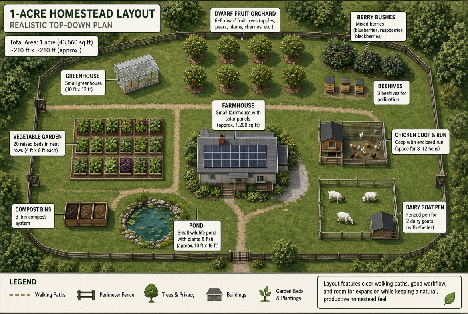
The 1-acre starter homestead
One acre can work surprisingly well.
You could divide it into:
- Home and driveway
- Intensive vegetable garden
- Small orchard
- Chicken area
- Compost area
- Greenhouse
- Storage
- Small lawn or outdoor space
The main disadvantage is limited room for large livestock and privacy.
Still, one acre can teach you most of the basic homestead skills.
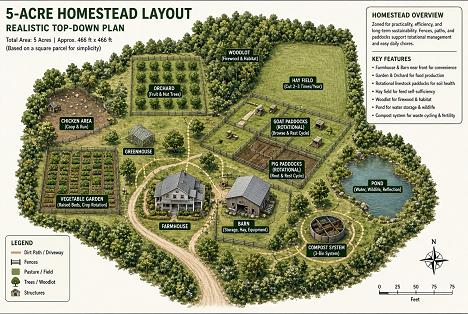
The 5-acre sweet spot
Five acres often offers a useful balance.
You can have a house, garden, orchard, chickens, small livestock, storage buildings, woodland, and recreation space.
You also gain room to make mistakes.
For many first-time buyers, this size feels large enough without creating an overwhelming amount of land to manage.
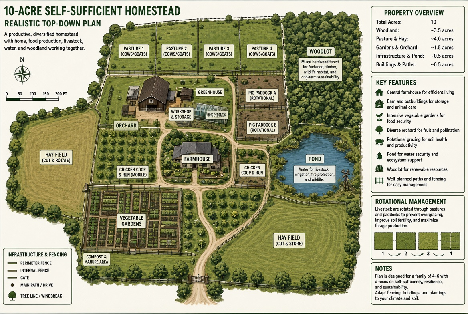
The 10-acre family setup
Ten acres can provide more flexibility.
You might dedicate two acres to gardens, orchard, and buildings while leaving other sections for pasture, woodland, wildlife, and future projects.
Additionally, ten acres can provide more privacy than a small suburban lot.
However, more land also means more fencing, mowing, maintenance, taxes, and travel around the property.
The 20-acre livestock plan
Twenty acres becomes more interesting for livestock.
You can divide pasture into sections and rotate animals when land conditions allow.
However, livestock capacity depends heavily on forage production. Good pasture can support more animals than poor pasture.
Therefore, local stocking guidance matters more than a simple acreage rule.
The 40-acre freedom model
Forty acres gives you many options.
You can separate your home from livestock, maintain woodland, grow crops, create wildlife areas, and plan for future buildings.
Yet 40 acres also creates more work.
You may need longer fences, larger equipment, more roads, and more time for maintenance.
Real-life planning example: the 2-acre family
Imagine a family buys two acres.
They place their house near the road, keep the back section for a garden, plant fruit trees along one boundary, and create a secure chicken run.
They do not try to grow everything.
Instead, they grow tomatoes, beans, squash, herbs, berries, and seasonal greens while buying grain and other staples.
This approach can work because they match their goals to their land.
Case study: the 5-acre learning farm
Consider a five-acre beginner homestead.
The owners use about half an acre for gardens and orchard space. Another acre supports small livestock. They leave the remaining land partly wooded.
During the first year, they focus on fencing, water, soil testing, compost, and garden skills.
By year three, they expand production.
This gradual model reduces expensive mistakes.
Case study: the 10-acre food plan
A ten-acre family could create several zones.
For example:
| Zone | Approximate space |
| Home and access | 1 acre |
| Garden | 1 acre |
| Orchard | 1 acre |
| Small livestock | 2 acres |
| Pasture | 3 acres |
| Woodland and wildlife | 2 acres |
This is only a planning example. Your soil, climate, zoning, and animal needs may change the numbers.
Advantages of buying more land
More land can provide:
- Greater privacy
- More room for animals
- Larger gardens
- More woodland
- Future expansion
- Space for workshops
- Better separation between neighbors
Furthermore, extra land can let you change your plans later.
That flexibility can be valuable when your homestead grows.
Disadvantages of buying more land
More acreage also creates costs.
You may need more fencing, equipment, mowing, taxes, repairs, roads, water lines, and labor.
Moreover, unused acreage can become an expensive asset that produces little value.
Therefore, buying 40 acres just because it sounds exciting may not be wise.
Expert advice: buy for your goals
A practical rule is simple: define the homestead first, then choose the acreage.
Ask yourself:
- How many people live there?
- What food will you grow?
- Which animals do you want?
- Do you need pasture?
- Do you want woodland?
- How much time can you work each week?
- What is your total budget?
Once you answer those questions, your land target becomes much clearer.
Soil can beat acreage
Good soil can make a small property powerful.
Before buying, consider a soil test and inspect drainage, slope, erosion, and past land use.
Also, look for areas with deep soil and good sunlight.
A property with excellent growing conditions can outperform a larger property with poor soil.
Water can beat cheap land
Cheap land often attracts buyers.
However, water problems can erase those savings quickly.
Before purchasing, confirm well records, water quality, local well depth, irrigation limits, and drought risk.
In addition, check how water moves across the property during heavy rain.
Zoning can change everything
Your dream homestead may not match local rules.
Some places limit livestock, farm buildings, manufactured homes, wells, septic systems, or additional dwellings.
Therefore, contact the county or municipal planning office before buying.
Do not rely only on a real estate listing.
Address for official U.S. farm data
For U.S. agricultural statistics, USDA National Agricultural Statistics Service provides official data and contact support.
USDA-NASS
1400 Independence Ave., SW
Washington, DC 20250
Phone: (800) 727-9540
You can also explore current land-value information through USDA NASS Land Values and USDA’s latest 2026 land-value report.
Updated 2026 land-value reality
Land prices continue to make acreage an important budget decision.
USDA reported that U.S. farm real estate averaged $4,500 per acre in 2026, up 3.4% from 2025. Cropland averaged $6,020 per acre, while pasture averaged $2,000 per acre.
These are national averages, not property prices.
Local land near cities can cost much more.
A smarter acreage buying formula
Instead of asking only how much land do you need to homestead, use this formula:
Required land = home space + food space + animal space + water space + access + future growth.
Then add a small buffer.
For example, if you need three acres for your current plan, looking at four or five acres may provide useful breathing room.
Common beginner mistake: buying too much
New homesteaders sometimes think more land automatically means more freedom.
In reality, unused land can create more work.
A five-acre property that you actively manage may be more useful than 50 acres that you cannot afford to fence or maintain.
Start with what you can handle.
Common beginner mistake: ignoring access
Land needs good access.
Check road conditions, driveway costs, emergency access, snow or flood problems, and whether large vehicles can reach your buildings.
Furthermore, check whether the property has legal access.
A beautiful remote parcel can become difficult if access rights are unclear.
Common beginner mistake: forgetting the future
Think five and ten years ahead.
Maybe you want goats later. Perhaps you want an orchard, guest cabin, barn, or larger garden.
If those plans matter, buy enough space now if your budget allows.
However, do not pay for huge acreage that you will never use.
A practical homestead acreage chart
Here is a simple decision guide:
| Your main goal | Good starting range | Main concern |
| Vegetables and herbs | 0.5–1 acre | Water |
| Garden + chickens | 1–2 acres | Zoning |
| Garden + orchard + chickens | 2–3 acres | Soil |
| Family homestead | 3–10 acres | Total workload |
| Goats or sheep | 5–15 acres | Pasture |
| Multiple livestock types | 10–20 acres | Feed |
| Cattle | 20+ acres | Stocking rate |
| Privacy + livestock + woodland | 20–40+ acres | Cost |
The best final number for most beginners
For many beginners, 3–5 acres is a strong target.
It gives you enough space to learn without forcing you to manage a huge property.
You can build a home, grow a serious garden, plant fruit trees, keep chickens, add small livestock, and reserve space for future projects.
Most importantly, choose land that fits your climate, budget, water supply, soil, and local rules.
Frequently Asked Questions
- How much land do you need to homestead if you are a beginner?
For many beginners, 1–5 acres can work well. Start with the amount you can afford and manage.
- Is one acre enough for a homestead?
Yes. One acre can support a house, garden, fruit trees, chickens, compost, and other small projects. However, large livestock will be difficult.
- Is five acres enough to live off the land?
Five acres can produce a lot of food, but complete food independence depends on crops, livestock, climate, soil, skills, and how much food you eat.
- Is 10 acres enough for a homestead?
Yes. Ten acres provides plenty of flexibility for a family homestead, especially if you want gardens, orchards, woodland, and small livestock.
- How much land do you need to homestead with cows?
There is no universal acreage number. Pasture quality and local stocking rates matter greatly, so ask a local livestock expert before buying.
- Can you homestead on 2 acres?
Absolutely. Two acres can support intensive gardening, chickens, fruit trees, a home, and several small projects.
- How much land do you need to homestead without animals?
You may need only 0.5–2 acres for a home, garden, orchard, greenhouse, compost, and food storage.
- Does homesteading require rural land?
No. You can homestead in suburban or even urban settings if local rules allow your planned activities.
- Can you homestead on 40 acres?
Yes. Forty acres can support a wide range of projects. However, managing that much land takes time and money.
- Does USDA require a minimum number of acres?
No. USDA’s statistical farm definition does not use a simple minimum-acreage rule. It uses agricultural production and sales criteria.
- How much land do you need to homestead for a vegetable garden?
A garden can start at a few hundred square feet. A serious family garden may use 2,000–10,000 square feet or more.
- Is cheap land good for homesteading?
Not always. Cheap land may have poor soil, weak water access, difficult roads, restrictive zoning, or expensive building costs.
- Should I buy more land for future growth?
If you can afford it, some extra land can help. However, avoid buying acreage that creates financial stress.
- Does woodland count as homestead land?
Yes, but woodland has different uses from open pasture or garden soil. Trees can provide privacy, wildlife habitat, firewood, and long-term value.
- How much land do you need to homestead for goats?
Several acres may support a small goat setup, but forage quality, fencing, weather, and supplemental feed can change the amount required.
- Can you make money from a small homestead?
Yes. Small farms can sell vegetables, eggs, seedlings, honey, flowers, crafts, and other products. USDA’s farm definition itself does not require hundreds of acres.
- How much land do you need to homestead for privacy?
There is no fixed number. Trees, terrain, neighboring properties, and road placement can make a small property feel private.
- What should I check before buying homestead land?
Check zoning, water, septic options, soil, access, flood risk, utilities, taxes, property boundaries, building rules, and animal restrictions.
- How much land do you need to homestead in 2026?
For a general starting point, 2–5 acres works well for many small family homesteads, while livestock-focused plans often need more.
- How much land do you need to homestead for complete self-sufficiency?
There is no universal number. A highly productive small property can provide many foods, while grains, livestock feed, fuel, and large animals can require much more land.
Final Thoughts
The better question is not simply how much land do you need to homestead. The better question is what do you want your homestead to do?
If you want vegetables, fruit, herbs, chickens, and a simple home, 1–3 acres may be enough. If you want a family homestead with more animals and room to grow, 3–10 acres is a practical target. If cattle, horses, large pasture, woodland, or serious privacy matter, look at 20 acres or more.
Most importantly, do not buy land based on acreage alone. Check water, soil, zoning, access, sunlight, flood risk, and total cost first.
USDA’s latest data also shows why location matters: the 2026 U.S. average farm real estate value reached $4,500 per acre, but regional and local prices vary greatly.
For current U.S. agricultural statistics, you can use USDA National Agricultural Statistics Service and USDA Economic Research Service farmland data.
The best homestead is not the biggest one. It is the property you can afford, understand, improve, and enjoy for years.


