 kdolu
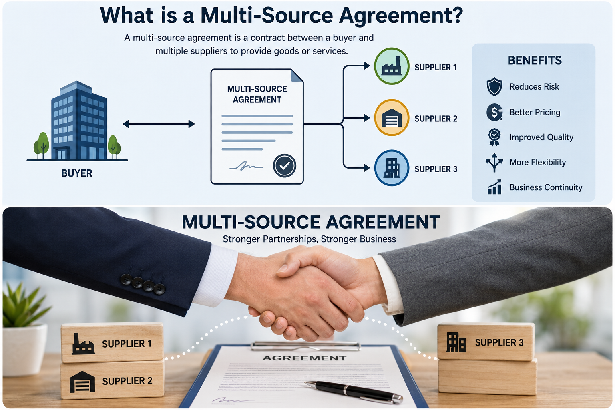
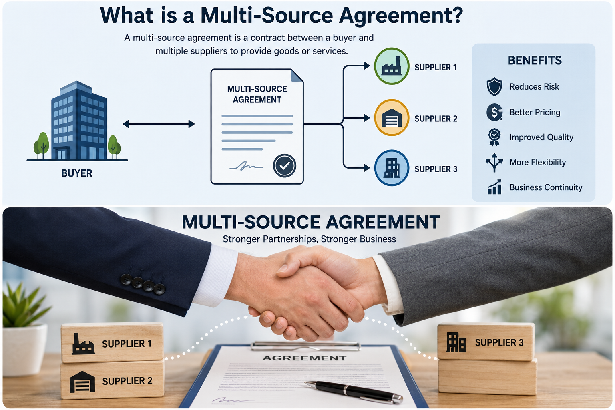
kdolu Multi-source agreement strategies have become very important in modern business. Today, companies do not want to depend on only one supplier, vendor, or service provider. Instead, they choose several sources to reduce risks, lower costs, and improve business operations.
Because supply chains can break down unexpectedly, many businesses now prefer a multi-source agreement. This type of agreement helps companies keep products and services available even during difficult times.
In this complete guide, you will learn everything about a multi-source agreement, including its meaning, benefits, disadvantages, examples, legal terms, and expert advice.
What Is a Multi-Source Agreement?
A multi-source agreement is a business contract where a company buys products or services from more than one supplier.
For example, a smartphone company may buy screens from one company and batteries from another company. In some cases, it may buy batteries from three different suppliers.
This approach helps businesses avoid depending on only one company.
Why Companies Use a Multi-Source Agreement
Businesses face many risks today. For example:
- Supplier failures
- Shipping delays
- Natural disasters
- Price increases
- Political problems
- Economic downturns
Because these issues can happen anytime, an agreement gives businesses more security.
History of Multi-Sourcing
Years ago, companies often used only one supplier because management was simpler.
However, global supply chain problems changed business thinking. The COVID-19 pandemic especially showed the danger of relying on one supplier.
As a result, many organizations moved toward a multi-source agreement.
How a Multi-Source Agreement Works
A company signs contracts with several suppliers.
Each supplier agrees to provide:
- Products
- Services
- Materials
- Technology support
- Software systems
The company then divides its orders among these suppliers.
Main Parts
A multi-source agreement usually includes:
Supplier Information
Names and contact details.
Products and Services
Everything being supplied.
Pricing Terms
Payment amounts and schedules.
Delivery Terms
Shipping times and responsibilities.
Quality Standards
Required product quality.
Exit Terms
Conditions for ending the agreement.
Types of Multi-Source Agreements
Strategic
Long-term partnerships with several suppliers.
Backup
Extra suppliers remain available during emergencies.
Global
Suppliers come from different countries.
Regional
Suppliers operate within one geographic region.
Multi-Source Agreement vs Single-Source Agreement
| Feature | Multi-Source Agreement | Single-Source Agreement |
| Suppliers | Multiple | One |
| Risk | Lower | Higher |
| Competition | More | Less |
| Flexibility | High | Low |
| Cost Control | Better | Moderate |
| Management | Complex | Simple |
Benefits
Reduces Supply Risks
If one supplier fails, another supplier can continue deliveries.
Creates Competition
Suppliers compete to offer better prices.
Improves Product Quality
Businesses can choose the best-performing suppliers.
Increases Flexibility
Companies can quickly change suppliers when necessary.
Supports Business Growth
Businesses can increase production faster.
Disadvantages
More Management Work
Managing several suppliers takes time.
Communication Challenges
Different suppliers may have different processes.
Higher Administrative Costs
More contracts mean more paperwork.
Quality Differences
Some suppliers may not meet the same standards.
When Businesses Need a Multi-Source Agreement
Companies should consider a agreement when:
- Products are critical.
- Demand changes often.
- Supply risks are high.
- Markets are uncertain.
- Business growth is rapid.
Industries
Many industries use a multi-source agreement, including:
- Healthcare
- Technology
- Manufacturing
- Retail
- Construction
- Transportation
- Government
- Telecommunications
Manufacturing
Manufacturers often use several suppliers for:
- Raw materials
- Packaging
- Electronic parts
- Machinery
This approach keeps production running smoothly.
Technology
Technology companies often need:
- Software developers
- Cloud providers
- Hardware manufacturers
- Security companies
Therefore, a multi-source agreement reduces dependence on one vendor.
Healthcare
Hospitals need:
- Medicines
- Medical equipment
- Protective supplies
During emergencies, several suppliers can save lives.
Government Contracts
Governments often use multiple vendors because they need:
- Better pricing
- Continuous service
- Reduced risk
- Greater competition
Retail
Retail businesses use several suppliers to avoid inventory shortages.
Large stores often work with hundreds of suppliers.
Construction
Construction companies may need:
- Cement suppliers
- Steel suppliers
- Equipment providers
- Safety equipment suppliers
A multi-source agreement helps avoid project delays.
Logistics
Logistics companies use:
- Multiple shipping providers
- Different warehouses
- Several transportation partners
This improves delivery speed.
How Companies Select Suppliers
Businesses usually evaluate:
- Price
- Quality
- Reputation
- Financial health
- Experience
- Delivery speed
Supplier Evaluation Methods
Scorecards
Companies score each supplier.
Audits
Teams inspect supplier operations.
Customer Reviews
Past performance matters.
Price Negotiation Tips
- Compare several offers.
- Set clear expectations.
- Discuss discounts.
- Review long-term pricing.
Quality Control Methods
Companies often:
- Inspect products.
- Test samples.
- Monitor performance.
- Conduct regular reviews.
Risk Management Strategies
A good multi-source agreement includes:
- Backup suppliers
- Emergency plans
- Insurance requirements
- Supply monitoring systems
Legal Terms
Pricing Clauses
Delivery Clauses
Liability Clauses
Confidentiality Terms
Termination Rights
Dispute Resolution Methods
Contract Duration
Some agreements last:
- One year
- Three years
- Five years
Long-term contracts often include renewal options.
Payment Terms
Payment schedules may include:
- Net 30 days
- Net 60 days
- Milestone payments
Service-Level Agreements
Service-level agreements define:
- Delivery times
- Response times
- Product quality standards
Confidentiality Clauses
Businesses protect:
- Trade secrets
- Customer information
- Financial data
Intellectual Property Rights
A multi-source agreement should explain who owns:
- Designs
- Software
- Patents
- Documents
Termination Clauses
Contracts explain:
- How to end the agreement
- Notice periods
- Financial obligations
Compliance Requirements
Suppliers may need to follow:
- Labor laws
- Environmental laws
- Safety regulations
Performance Monitoring
Companies often measure:
- Delivery rates
- Product quality
- Customer satisfaction
Supplier Communication
Regular meetings improve relationships and solve problems faster.
Technology Tools for Multi-Sourcing
Businesses use:
- Supply chain software
- Contract management systems
- Analytics platforms
Useful resources:
Real-Life Example
Apple works with many suppliers around the world. The company does not depend on one manufacturer for all parts.
This strategy reduces supply risks and improves production stability.
Case Study 1: Automotive Industry
A car company relied on one chip supplier.
When that supplier experienced delays, production stopped.
Later, the company created a multi-source agreement with three suppliers.
As a result:
- Production improved.
- Risks decreased.
- Revenue increased.
Case Study 2: Healthcare Industry
A hospital depended on one medical supplier.
During a crisis, supplies became unavailable.
After signing a multi-source agreement, the hospital maintained steady inventory.
Advantages and Disadvantages Chart
| Advantages | Disadvantages |
| Lower risk | More administration |
| Better pricing | Complex management |
| More flexibility | More communication |
| Better quality | Higher monitoring costs |
| Business continuity | Contract complexity |
Best Practices
Create Clear Contracts
Set Performance Standards
Monitor Suppliers
Build Strong Relationships
Review Contracts Regularly
Maintain Backup Plans
Common Mistakes
- Choosing suppliers only because of low prices.
- Ignoring quality checks.
- Failing to monitor performance.
- Using unclear contracts.
- Not having backup plans.
Future Trends
Several trends continue to grow:
- Artificial intelligence
- Supply chain automation
- Predictive analytics
- Sustainable sourcing
- Global supplier networks
Expert Advice
Supply chain experts recommend:
- Never depend on one supplier.
- Build strong supplier relationships.
- Review risks regularly.
- Use technology tools.
- Update agreements every year.
Frequently Asked Questions
- What is a multi-source agreement?
A contract involving multiple suppliers.
- Why is it important?
It reduces business risk.
- Who uses multi-source agreements?
Businesses, governments, and nonprofits.
- Does it save money?
Often, yes.
- Is it difficult to manage?
It can be.
- What industries use it?
Many industries use it.
- Can small businesses use it?
Yes.
- Does it improve quality?
Usually, yes.
- Can it prevent shortages?
Yes.
- Is it legally binding?
Yes.
- How many suppliers are ideal?
It depends on the business.
- Does it reduce risk?
Absolutely.
- What happens if one supplier fails?
Others can continue.
- Does it require more paperwork?
Yes.
- Is it good for manufacturing?
Yes.
- Can software companies use it?
Yes.
- Is it suitable for healthcare?
Definitely.
- How often should contracts be reviewed?
At least yearly.
- Can companies switch suppliers?
Yes, depending on the contract.
- Is multi-sourcing growing?
Yes, very quickly.
Conclusion
A multi-source agreement gives businesses more flexibility, lower risk, and stronger supply chains. Although managing several suppliers requires more work, the benefits usually outweigh the challenges.
Today, companies around the world depend on a multi-source agreement to protect their operations and improve business performance. As global markets become more uncertain, businesses that use smart multi-sourcing strategies will likely remain stronger and more competitive in the future.
For additional information about supply chain management, you can visit: