
 kdolu
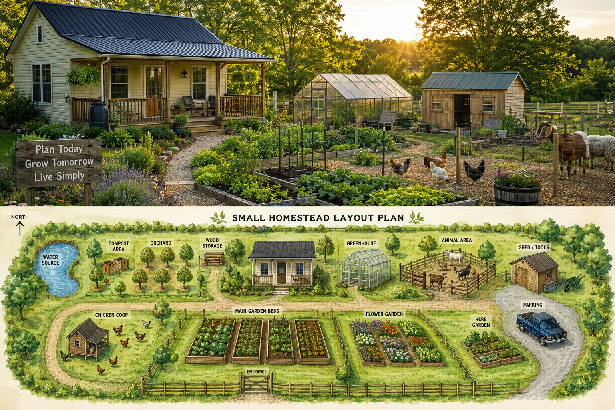
kdolu Small homestead planning guide ideas can help you turn a small piece of land into a useful, productive, and enjoyable home. However, good homesteading does not begin with buying chickens, planting 100 tomato plants, or building a huge barn. Instead, it begins with a clear plan.
A small homestead can provide fresh vegetables, herbs, eggs, fruit, and other useful resources. It can also teach children where food comes from and help families spend more time outside. However, a homestead also takes time, money, work, and patience.
Therefore, the best plan starts small.
You do not need 20 acres to begin. You do not need expensive equipment. Most importantly, you do not need to do everything during your first year.
This complete guide explains how to plan a small homestead from the ground up. It covers land, water, soil, gardens, animals, buildings, tools, food storage, money, time, safety, and long-term growth.
It also includes a planning chart, advantages and disadvantages, real-life examples, case studies, expert guidance, and 20 frequently asked questions.
Why a Small Homestead Planning Guide Matters
A small homestead planning guide gives you a simple path before you spend money.
First, you need to understand what you want from your land. Maybe your main goal is growing food. Perhaps you want chickens and fresh eggs. You may also want fruit trees, a kitchen garden, a few goats, or a quiet country lifestyle.
However, every goal needs space and work.
For example, a vegetable garden needs good sunlight and water. Chickens need shelter, fencing, feed, and protection from predators. Fruit trees need enough room to grow. Therefore, placing everything without a plan can create problems later.
USDA recommends thinking about a farm operation from the ground up and building a plan around goals, resources, operations, finances, and risks.
So, planning is not paperwork for its own sake. Instead, planning helps you make better choices.
Small Homestead Planning Guide: Start With Your Main Goal
Before you draw a map, write down your main reason for homesteading.
Ask yourself:
- Why do I want a homestead?
- What food do I want to grow?
- Do I want animals?
- Do I want to sell anything?
- How much time can I work each week?
- How much money can I spend?
- Do I want to live on the land full time?
- What do I want the homestead to look like in five years?
Next, choose three major goals.
For example:
Goal 1: Grow enough vegetables for the family.
Goal 2: Keep six to eight laying hens.
Goal 3: Plant a small fruit orchard.
This approach keeps the project manageable.
Write a One-Page Homestead Vision
A one-page vision can make your plan much easier.
Write a short paragraph describing your ideal homestead. Then list the things you want to achieve during your first year.
For example:
“We want a simple family homestead with a vegetable garden, fruit trees, chickens, compost, rainwater collection where legal, and a small food storage area.”
Then create a second list called “Not Yet.”
Put big projects there.
For example:
- Dairy cow
- Large barn
- Big greenhouse
- Tractor
- Commercial farm business
- Large orchard
- Multiple livestock species
This step matters because beginners often try to do too much.
Small Homestead Planning Guide: Choose the Right Land
Land selection can make or break your homestead.
Therefore, do not choose land only because it looks beautiful or has a low price.
Instead, inspect the land carefully.
Look at:
- Soil
- Sunlight
- Water
- Drainage
- Flood risk
- Road access
- Electricity
- Building rules
- Property boundaries
- Neighboring land
- Wildlife
- Slope
- Existing buildings
USDA notes that soil surveys can help farmers understand crop potential, drainage issues, flooding risks, water tables, and other land limits.
So, research the property before buying it.
Small Homestead Planning Guide: Understand Your Soil
Good soil is one of your greatest homestead assets.
Fortunately, you do not need perfect soil.
Instead, you need to understand what you have.
Start with a soil test. A local agricultural extension office or soil testing service can often help.
Test for basic factors such as:
- Soil pH
- Nutrient levels
- Organic matter
- Drainage concerns
- Possible contamination where relevant
Next, look at the soil yourself.
Does it hold water for days?
Does it become hard when dry?
Does it drain very quickly?
Does it have earthworms?
Does it smell healthy?
These clues can help, although laboratory testing gives you better information.
Study the Sun Before Planting
Sunlight can be more important than many beginners expect.
Most common vegetables need several hours of direct sunlight.
Therefore, watch your property during different times of day.
Mark areas that receive:
- Full sun
- Morning sun
- Afternoon sun
- Partial shade
- Heavy shade
Then repeat the observation during different seasons if possible.
A spot that looks sunny in summer may become shaded by trees during another season.
So, do not rush to build your garden.
Watch first.
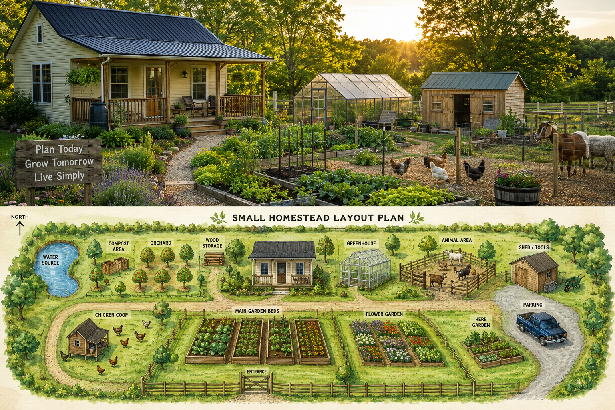
Small Homestead Planning Guide: Make a Simple Land Map
You do not need expensive software.
A notebook, pencil, measuring tape, and graph paper can work.
Draw your property.
Then add:
- House
- Driveway
- Well
- Water lines
- Septic area
- Trees
- Garden
- Animal areas
- Compost
- Storage
- Paths
- Fences
- Future projects
Next, draw arrows showing how you move around the property.
For example, chickens should not require a 10-minute walk every morning.
Likewise, the garden should not be placed so far from water that watering becomes a daily struggle.
Small Homestead Planning Guide: Put Daily-Use Areas Nearby
A useful rule is simple:
Put frequently used areas close to your home.
Place herbs, salad greens, and daily chicken access near the house.
Put larger projects farther away.
For example:
Near the house:
- Kitchen garden
- Herb garden
- Chicken coop
- Compost
- Tool shed
Farther away:
- Orchard
- Firewood
- Larger animal pasture
- Storage
- Future expansion
This layout can save time every day.
Plan Water Before You Plan Crops
Water is one of the first things you should study.
Ask:
- Where does household water come from?
- Is irrigation available?
- Can water reach the garden?
- Does the property flood?
- Where does rainwater flow?
- Are there dry months?
- What water storage options are legal in your area?
Also, check local rules before changing drainage or building water systems.
Water problems can become expensive quickly.
Therefore, make water part of your first land assessment.
Small Homestead Planning Guide: Build a Garden That Fits Your Life
A common mistake is building a garden that is too large.
Instead, begin with a garden you can care for.
For a beginner, a small garden might include:
- Tomatoes
- Cucumbers
- Beans
- Lettuce
- Carrots
- Radishes
- Peppers
- Herbs
- Squash
Choose foods your family actually eats.
There is little value in growing 30 pounds of a vegetable nobody likes.
Use a Simple Garden Layout
You can divide your garden into sections.
For example:
| Garden Area | Crops | Main Need |
| Bed 1 | Tomatoes | Sun and support |
| Bed 2 | Beans | Support and regular picking |
| Bed 3 | Carrots | Loose soil |
| Bed 4 | Lettuce | Cooler conditions |
| Bed 5 | Herbs | Easy access |
| Bed 6 | Cucumbers | Space to spread or climb |
This simple system makes crop care easier.
Also, leave enough walking space.
A garden should be easy to work in, not packed so tightly that you cannot reach the plants.
Small Homestead Planning Guide: Think About Food Storage
Growing food is only half the job.
You also need to think about what happens after harvest.
Possible methods include:
- Freezing
- Drying
- Canning
- Fermenting
- Root storage
- Cool storage
- Pickling
However, food preservation requires safe methods.
For example, do not guess about pressure canning or low-acid foods. Use trusted food safety guidance.
The USDA Complete Guide to Home Canning and the National Center for Home Food Preservation provide tested information for safe home food preservation.
Decide Which Animals Fit Your Homestead
Animals can be useful.
However, they also create daily work.
Before getting an animal, consider:
- Shelter
- Feed
- Water
- Fencing
- Veterinary care
- Predator protection
- Waste management
- Winter care
- Summer heat
- Local laws
Chickens may be easier for many beginners than larger livestock.
Still, chickens are not maintenance-free.
They need daily care.
Small Homestead Planning Guide: Start With One Animal System
Instead of buying several species, start with one.
For example, begin with chickens.
Learn how to:
- Build or buy a coop
- Protect birds
- Store feed
- Collect eggs
- Manage bedding
- Handle manure
- Watch for illness
- Protect water
Then, after you gain experience, consider another animal.
This slow approach reduces mistakes.
Choose Chickens With Care
If eggs are your goal, laying hens can be a practical starting point.
However, research your local climate and available breeds.
Also, check local rules about poultry.
Your chicken area should provide:
- Dry shelter
- Good airflow
- Protection from predators
- Clean water
- Safe feed storage
- Enough room to move
- Easy cleaning access
Most importantly, build security into the coop.
A cheap coop can become expensive if predators repeatedly get inside.
Small Homestead Planning Guide: Consider Fruit Trees Early
Fruit trees can take years to produce well.
Therefore, they are worth planning early.
Choose fruit based on:
- Local climate
- Soil
- Available sunlight
- Water
- Space
- Family preference
- Pollination needs
Possible choices may include:
- Apples
- Pears
- Peaches
- Plums
- Figs
- Citrus
- Cherries
However, the right choices depend heavily on your location.
Local agricultural experts can help you select varieties suited to your area.
Build a Small Orchard Instead of a Huge One
You do not need 50 trees.
Start with a few.
For example:
- Two apple trees
- Two peach trees
- Two plum trees
However, check pollination needs before buying.
Some fruit trees need compatible varieties nearby.
Also, consider mature tree size.
A small tree can become a large tree.
Therefore, follow recommended spacing.
Small Homestead Planning Guide: Create a Compost System
Compost can turn kitchen and garden waste into useful soil material.
A simple system may include:
- Vegetable scraps
- Fruit scraps
- Dry leaves
- Grass clippings
- Plant material
- Small amounts of other suitable organic matter
Keep meat, oils, and other materials out unless your compost method specifically handles them.
Also, keep the pile balanced.
Too much wet material can create bad smells.
Too much dry material can slow decomposition.
Therefore, mix materials and keep the pile reasonably moist.
Plan Your Fences Before Your Animals
Fencing is one of the most important homestead projects.
Good fencing can:
- Keep animals inside
- Keep predators outside
- Protect gardens
- Separate species
- Protect young plants
- Create safe work areas
However, fence type depends on the animal.
A chicken fence will not necessarily contain goats.
Likewise, a garden fence may not stop every animal.
So, match your fence to its job.
Small Homestead Planning Guide: Make Paths Easy to Use
Paths may seem unimportant.
However, good paths can save hundreds of steps.
Think about your daily route.
For example:
House → chicken coop → garden → compost → tool shed
Try to make that route simple.
Also, avoid placing paths where rain creates deep mud.
Good paths make the homestead easier to maintain in every season.
Choose Tools That You Will Actually Use
You do not need a giant tool collection.
Start with useful basics:
- Hand trowel
- Garden fork
- Shovel
- Hoe
- Rake
- Pruning shears
- Wheelbarrow
- Gloves
- Hose
- Measuring tape
- Buckets
- Basic repair tools
Then buy more tools when a real need appears.
Renting or borrowing large equipment can also save money.
Small Homestead Planning Guide: Create a First-Year Budget
Money problems can stop a homestead faster than poor soil.
Therefore, create a simple budget before buying anything.
Separate costs into:
One-time costs
- Fencing
- Garden beds
- Tools
- Coop
- Shed
- Water system
- Orchard trees
Repeating costs
- Seeds
- Feed
- Bedding
- Repairs
- Electricity
- Fuel
- Animal care
- Fertilizer where needed
Also create an emergency fund.
Unexpected repairs happen.
Use a Homestead Cost Chart
Here is a sample planning chart. These are example categories, not fixed prices, because local costs vary.
| Project | Small Start | Medium Start | Main Cost Risk |
| Vegetable garden | Low | Medium | Water and fencing |
| Chicken system | Low | Medium | Coop and predator protection |
| Compost | Very low | Low | Bin or space |
| Fruit trees | Low | Medium | Trees and irrigation |
| Tool collection | Low | Medium | Buying too much |
| Fencing | Medium | High | Land size |
| Shed | Medium | High | Materials |
| Irrigation | Low | High | Water source |
| Greenhouse | Medium | High | Frame and covering |
| Tractor | High | Very high | Purchase and maintenance |
The lesson is simple: start with projects that give you value without creating large fixed costs.
Small Homestead Planning Guide: Protect Your Time
Time is another form of cost.
A garden may save money on food, but it requires planting, watering, weeding, harvesting, and storage.
Animals require even more regular care.
Therefore, create a weekly schedule.
For example:
Monday: Garden check
Tuesday: Animal care and fence check
Wednesday: Harvest and food storage
Thursday: Garden work
Friday: Equipment check
Saturday: Larger project
Sunday: Rest and planning
The exact schedule will change, but the idea remains useful.
Avoid the “Do Everything” Trap
Many new homesteaders feel excited.
They want:
- Chickens
- Goats
- Bees
- Orchard
- Huge garden
- Greenhouse
- Dairy
- Canning
- Baking
- Solar power
- Rainwater storage
- Woodlot
- Farm business
That list can become overwhelming.
Instead, choose one major project per season.
This approach gives you time to learn.
Small Homestead Planning Guide: Create a Three-Year Roadmap
A three-year plan can make growth easier.
Year One
Focus on:
- Garden
- Compost
- Basic tools
- Chickens if suitable
- Soil improvement
- Water planning
Year Two
Add:
- Fruit trees
- Better storage
- Expanded garden
- More fencing
- Improved irrigation
Year Three
Consider:
- Greenhouse
- More livestock
- Small farm sales
- Larger food storage
- Improved buildings
However, do not follow this plan blindly.
Your land and family needs should guide the pace.
Study Local Rules Before Building
This step can save you serious trouble.
Check local rules for:
- Livestock
- Poultry
- Building permits
- Septic systems
- Wells
- Fences
- Water collection
- Food sales
- Home businesses
- Property use
Rules differ greatly by country, state, county, and city.
Therefore, contact the correct local authority before construction.
For U.S. readers, the USDA National Agricultural Library provides a useful overview of legal considerations for small farms.
Small Homestead Planning Guide: Protect the Soil
Healthy soil supports almost everything else.
You can improve soil by:
- Adding suitable organic matter
- Using mulch
- Avoiding unnecessary soil disturbance
- Keeping soil covered
- Rotating crops
- Reducing erosion
- Managing water carefully
NRCS provides conservation standards and technical guidance based on soil, water, plants, animals, and local conditions.
You can also contact your local NRCS office in the United States for technical assistance.
Plan for Bad Weather
A strong homestead plan includes problems.
Think about:
- Drought
- Flooding
- Strong wind
- Extreme heat
- Cold weather
- Heavy rain
- Pests
- Crop failure
- Power outages
- Animal emergencies
Then create backup plans.
For example, keep extra feed where appropriate, protect important tools from weather, and know where animals can go during storms.
Small Homestead Planning Guide: Think About Security
Security is not only about people.
It also means protecting your food, animals, tools, and buildings.
Use:
- Strong locks
- Secure feed storage
- Good lighting
- Reliable fencing
- Safe chemical storage
- Tool organization
- Animal-proof gates
Keep dangerous tools and chemicals away from children.
Also, teach children how to behave around animals.
Build a Homestead First-Aid and Emergency Kit
Keep a basic emergency kit in an easy-to-find place.
It may include:
- Flashlight
- Batteries
- First-aid supplies
- Work gloves
- Clean water
- Emergency food
- Basic tools
- Phone power bank
- Important contact numbers
For animals, keep emergency supplies recommended by your veterinarian.
Small Homestead Planning Guide: Use Companion Planting Carefully
Companion planting can be fun.
However, do not treat every online planting chart as proven fact.
Instead, focus on simple garden practices that have clear benefits.
For example:
- Mix crops to use space well.
- Grow flowers that support useful insects.
- Keep tall crops from shading short crops.
- Rotate crop families.
- Keep paths open.
Good garden design matters more than following a huge list of “perfect” plant combinations.
Plan for Seeds and Crop Rotation
Keep notes about what you plant.
Write down:
- Crop
- Variety
- Planting date
- Harvest date
- Problems
- Yield
- Weather
- What you liked
Then use these notes next year.
Crop rotation can also help you avoid planting the same crop family in exactly the same place every year.
A notebook can become one of your best homestead tools.
Small Homestead Planning Guide: Learn From Every Season
Your first year will not be perfect.
That is normal.
Maybe the tomatoes fail.
Maybe the chickens escape.
Maybe your garden becomes too large.
Maybe you buy a tool you never use.
Instead of feeling defeated, record the lesson.
Ask:
What worked?
What failed?
What cost too much?
What took too much time?
What should I change next year?
That review turns mistakes into experience.
Real-Life Example: The One-Acre Family Homestead
Consider a fictional family named the Rahman family.
They have about one acre.
At first, they want chickens, goats, vegetables, fruit trees, and a greenhouse.
However, they realize that the list is too large.
So, they begin with:
- Small vegetable garden
- Six hens
- Compost
- Four fruit trees
- Basic tool shed
During the first year, they learn how much work each project requires.
Then, in year two, they add more fruit trees and improve the garden.
This example shows why starting small often works better than trying to build everything immediately.
Case Study: A Small Homestead That Grew Slowly
Imagine another family with five acres.
They do not farm all five acres.
Instead, they use only part of the property.
The first year includes:
- ¼-acre garden
- Small chicken area
- Compost
- Orchard section
- Walking paths
The remaining land stays mostly untouched.
That decision saves time.
Later, the family expands only after learning which projects provide the most value.
This is a smart lesson for beginners: unused land is not wasted land.
Sometimes, leaving land alone is part of a good plan.
Expert Advice: Think Like a Planner First
USDA guidance stresses clear goals, planning, financial review, risk management, conservation, and careful decisions before expanding an agricultural operation.
NRCS also encourages landowners to discuss their vision with conservation staff and develop plans around land resources.
Therefore, expert advice for beginners can be summed up simply:
Do not ask, “What can I build?”
Instead, ask:
“What does my land and family actually need?”
That question can prevent many expensive mistakes.
Small Homestead Planning Guide: Know the Advantages
Small homesteading can offer many benefits.
Fresh food
You can grow food close to home.
Better food awareness
You know how your vegetables were grown.
Outdoor time
Homesteading encourages movement and time outside.
Family learning
Children can learn about plants, animals, seasons, and responsibility.
Lower food costs
A productive garden can reduce some grocery purchases, although it does not make food free.
Personal satisfaction
Growing something from seed to harvest can feel rewarding.
Resilience
A productive garden and stored food can provide useful backup during disruptions.
Understand the Disadvantages
Homesteading is not always easy.
It takes time
Plants need care.
Animals need daily attention.
It can cost money
Fencing, tools, buildings, feed, and repairs add up.
Weather can ruin crops
A storm or drought can cause major losses.
Animals create responsibility
You cannot simply stop caring for animals when you get busy.
Maintenance never fully ends
Fences break.
Tools wear out.
Buildings need repairs.
It may not save money immediately
Buying seeds, soil amendments, tools, fencing, and equipment can cost more than expected.
Therefore, think of homesteading as a long-term lifestyle project, not a quick way to get rich.
Small Homestead Planning Guide: Create a Decision Scorecard
When choosing a new project, score it from 1 to 5.
| Question | Score 1–5 |
| Does my family need it? | |
| Can I afford it? | |
| Do I have enough time? | |
| Do I have enough space? | |
| Can I maintain it? | |
| Does it improve the homestead? | |
| Can I start small? | |
| Is it safe? | |
| Does it fit local rules? | |
| Will I still want it next year? |
If the total score is low, wait.
This simple system can stop impulse purchases.
Plan Your Homestead Around Energy
Think about how much physical work each system requires.
A vegetable garden may need frequent attention.
A large livestock system may need daily care.
A fruit orchard may require seasonal work but less daily care once established.
Therefore, balance high-work and lower-work systems.
For example:
High daily work: chickens
Medium seasonal work: garden
Lower daily work: established fruit trees
This balance can make your homestead more enjoyable.
Small Homestead Planning Guide: Make Your Home Part of the System
Your house can work together with your land.
For example:
- Kitchen scraps can go to compost.
- Compost can support the garden.
- Garden harvest can support meals.
- Vegetable leftovers can sometimes support appropriate livestock systems.
- Leaves can become mulch or compost.
- Rain can sometimes support approved water systems.
This creates a simple cycle.
The goal is not perfection.
Instead, the goal is reducing waste where practical.
Plan Storage Before Harvest Season
A large harvest can become a problem if you have nowhere to put it.
Before planting large amounts, ask:
Where will I store this?
Plan for:
- Jars
- Freezer space
- Dry storage
- Shelves
- Baskets
- Cool storage
- Drying space
Also, label stored food.
Write the date and contents.
Good storage helps prevent waste.
Small Homestead Planning Guide: Build Skills Before Buildings
You can learn many skills without owning a large property.
Practice:
- Seed starting
- Composting
- Basic gardening
- Food preservation
- Pruning
- Tool care
- Simple repairs
- Animal care
- Meal planning
- Budgeting
Then, when you buy land, you already have useful knowledge.
This can save money.
Create Your Final Homestead Master Plan
Now combine everything into one document.
Your master plan should include:
Land
- Property size
- Soil
- Sun
- Water
- Drainage
Food
- Garden
- Orchard
- Storage
- Preservation
Animals
- Species
- Housing
- Feed
- Fencing
Buildings
- House
- Shed
- Coop
- Future structures
Money
- Start-up budget
- Monthly costs
- Emergency fund
- Future projects
Time
- Daily chores
- Weekly work
- Seasonal jobs
Growth
- Year one
- Year two
- Year three
This document becomes your roadmap.
A Simple Small Homestead Planning Guide Checklist
Use this checklist before starting.
Land checklist
- Check property rules.
- Study the soil.
- Check water access.
- Watch sunlight.
- Study drainage.
- Check flood risk.
- Mark property boundaries.
- Identify existing trees.
- Locate utilities.
Garden checklist
- Start with a manageable size.
- Choose foods your family eats.
- Plan irrigation.
- Build paths.
- Add compost.
- Keep garden notes.
- Plan storage.
Animal checklist
- Check local rules.
- Choose one species first.
- Build secure housing.
- Plan fencing.
- Plan feed storage.
- Find animal-care support.
- Prepare for emergencies.
Money checklist
- Create a starting budget.
- Track every purchase.
- Avoid unnecessary equipment.
- Keep an emergency fund.
- Estimate yearly running costs.
Frequently Asked Questions About Small Homesteads
- What is a small homestead?
A small homestead is a property where people produce some of their own food or useful resources. It may include a garden, chickens, fruit trees, compost, and other small-scale systems.
- How much land do I need for a small homestead?
There is no single perfect acreage. A small homestead can work on a small urban lot, suburban property, one acre, or several acres. Your goals matter more than the number alone.
- Is one acre enough for a homestead?
Yes, one acre can support a useful homestead when you plan carefully. However, it may not support every type of livestock or large-scale food production.
- What should I grow first?
Start with vegetables your family already eats. Tomatoes, beans, greens, herbs, cucumbers, and peppers can be useful choices, depending on your climate.
- Should beginners start with chickens?
Chickens can be a reasonable first livestock choice for some families. However, always check local rules and understand the daily care they require.
- How much does a small homestead cost?
Costs vary widely. Land, fencing, water systems, buildings, tools, animals, and local prices all affect the total. Start with a budget rather than assuming a fixed number.
- Can a small homestead save money?
It can reduce some food expenses, especially when you grow foods you regularly eat. However, start-up costs can be high, so savings may take time.
- Should I buy a tractor?
Usually, beginners should not rush into buying a tractor. First, determine whether you truly need one. Renting, hiring help, or using hand tools may work better for a small property.
- What is the most important part of a homestead?
There is no single answer. Soil, water, time, money, food production, and good planning all matter.
- Should I build a greenhouse first?
Not necessarily. A greenhouse can be useful, but a simple garden may provide more value during your first season.
- How can I avoid becoming overwhelmed?
Start with one garden and one simple animal system, if desired. Then expand only after you understand the workload.
- Do I need to grow all my own food?
No. Most small homesteaders do not need to produce everything they eat. Grow the foods that give your family the most value.
- How can I improve poor soil?
Start with a soil test. Then use suitable soil-building methods based on the test results and local advice. NRCS soil resources can also help landowners understand soil limits and management options.
- What should I do if I have little money?
Start with low-cost projects such as a small garden, compost, basic tools, and skill building. Avoid large buildings and expensive equipment until you know you need them.
- Should I sell food from my homestead?
You can consider selling products if local laws allow it. However, food safety, licenses, taxes, labeling, and market rules may apply. Research the rules before selling.
- Can children help on a homestead?
Yes. Children can help with age-appropriate tasks such as watering plants, collecting suitable produce, and learning about gardens. However, adults should supervise animals, tools, machinery, and other hazards.
- What is the biggest beginner mistake?
Trying to do everything at once is one of the biggest problems. A smaller plan is usually easier to manage.
- Should I buy land before making a plan?
It is better to define your needs first. Then use those needs when comparing properties. USDA also recommends considering land, finances, equipment, operations, conservation, and risk when planning an agricultural operation.
- Can I create a homestead on rented land?
Possibly. However, you need clear permission for gardens, trees, fencing, animals, buildings, and other improvements. Put important agreements in writing.
- What is the best advice for a new homesteader?
Start small, learn every season, track your money, protect your soil, plan your water, and expand slowly.
Useful External Resources for Homestead Planning
Reliable information matters, especially when decisions involve land, animals, food safety, money, or conservation.
For U.S. readers, these resources are useful:
- USDA Farmers.gov: Plan Your Farm Operation — helpful for setting goals, planning operations, reviewing finances, and managing risks.
- USDA Beginning Farmers and Ranchers — offers information for people who are starting or growing a farm operation.
- USDA NRCS Soil Resources — useful for soil planning and conservation help.
- USDA Soil Surveys — helps landowners understand soil limitations and land-use possibilities.
- USDA Small Farm Funding Guide — provides links to farm business planning, funding, technical assistance, and related resources.
- National Agricultural Library: Legal Considerations for Small Farms — useful for learning about legal and business issues.
- National Center for Home Food Preservation — useful for safe home food preservation guidance.
If you live outside the United States, use your local agriculture ministry, agricultural extension service, soil-testing service, and local government because land and farming rules can differ.
Small Homestead Planning Guide: A Practical First-Year Plan
Here is a simple way to turn your ideas into action.
Month 1: Learn
First, study your land.
Map it.
Watch the sun.
Check water.
Learn about your soil.
Research local rules.
Do not rush.
Month 2: Prepare
Next, create your garden plan.
Buy only basic tools.
Prepare compost.
Plan fencing.
Create a budget.
Month 3: Plant
Then, start your first crops according to your local growing season.
Keep the garden small.
Label your plants.
Track what you do.
Months 4–6: Learn
Now, focus on care.
Watch pests.
Improve watering.
Fix weak fences.
Learn which plants grow best.
Do not expand too quickly.
Months 7–9: Harvest
Next, harvest regularly.
Store food safely.
Record your yields.
Write down what your family likes.
Also, note what took too much work.
Months 10–12: Review
Finally, review the entire year.
Ask:
- What worked?
- What failed?
- What cost too much?
- What gave us the most value?
- What should we stop doing?
- What should we improve?
- What should we add next year?
That review becomes the foundation for your next season.
Final Thoughts
A successful homestead does not have to look like a giant farm.
In fact, a small property can provide many useful things when you plan it well.
The key is to match your dreams with your land, budget, time, and skills.
Start with your goals. Then study your property. Next, plan water, soil, food, animals, paths, storage, and money. After that, build only what you need.
Most importantly, grow slowly.
A good small homestead planning guide should not push you to buy more land, more animals, or more equipment than you can handle. Instead, it should help you create a system that fits your real life.
Remember that your first garden does not need to be perfect. Your first chicken coop does not need to look like a magazine photo. Your first harvest may be small. That is okay.
Every season teaches you something.
USDA resources also emphasize that no single solution fits every farm or landowner, so decisions should match the goals and conditions of the individual operation.
Therefore, make your homestead simple.
Start small. Learn often. Spend carefully. Protect your soil. Save your harvest. Take care of your animals. And expand only when you are ready.
That is how a small piece of land can slowly become a productive and rewarding homestead.


